


Why these two fungi return every year
Apple scab and powdery mildew are the two leaf problems most of us meet in a British orchard, whether that is three trees at the end of the garden, a row of half-standards in a paddock or an old cider orchard on heavy clay. Neither arrives by chance. Both overwinter on or close to the tree, and both are encouraged by the same underlying fault: a canopy that stays damp and crowded for too long. Understand their habits and you can let the tree's own shape do much of the work, rather than chasing sprays all season.
It also helps to know that scab and mildew have quite different tastes. Scab is a creature of wet weather; mildew is happiest in warm, dry spells with humid air. A wet spring tends to bring scab, a dry one mildew, and a mixed season can bring both.
Apple scab: dark blotches that ride in on the rain
Scab shows first as soft, olive-green patches on the upper leaf surface, often near the edges. Those patches darken to a dull blackish-brown and take on a velvety, slightly raised look. Leaves may pucker, twist and drop early, and on the fruit you will see corky, brown, cracking scars that spoil the appearance but rarely the eating.
The fungus spends the winter in fallen leaves on the ground. In spring, during wet spells from bud burst through to early June, spores are released and splashed upward onto the developing leaves. A leaf that stays wet for roughly a day at around 15–20°C is vulnerable, which is why long, drizzly spells matter far more than total rainfall. Once established, the disease keeps cycling through the summer, spreading from leaf to leaf in wet weather. It matters less on cider fruit, since a bit of skin scab barely troubles the juice, but on dessert apples it can be disfiguring.
Powdery mildew: pale felt on the growing tips
Mildew looks like a dusting of white-grey flour, mostly on the undersides of young leaves and along the soft tips of shoots. Infected leaves curl, narrow and become brittle; affected shoots are stunted and often take on a silvery, frosted appearance. On the fruit it can cause a fine russeting rather than a scab.
Its trick is overwintering inside the buds. Those infected buds break later than the rest and emerge already coated in white felt, giving the disease its crucial head start. Unlike scab, mildew does not need free water on the leaf. Warm days around 15–25°C with humid air and no rain suit it perfectly, and it spreads fastest through soft, lush, shaded growth.
Telling them apart, and what else it might be
Run a finger over the patch. Scab is a stained, velvety blotch that will not rub off. Mildew is powdery and will smear. Beyond that, a few lookalikes are worth ruling out:
- Sooty mould is black but sits on top of sticky honeydew left by aphids, and wipes away easily.
- Aphid damage curls and puckers leaves, often with sticky residue and ants in attendance, but without the characteristic blotches.
- Nutrient deficiencies tend to yellow or pale whole leaves evenly, rather than forming discrete dark patches.
- Mite feeding gives a fine pale speckling or bronzing across the leaf, not defined blotches or floury growth.
Prune for light and moving air
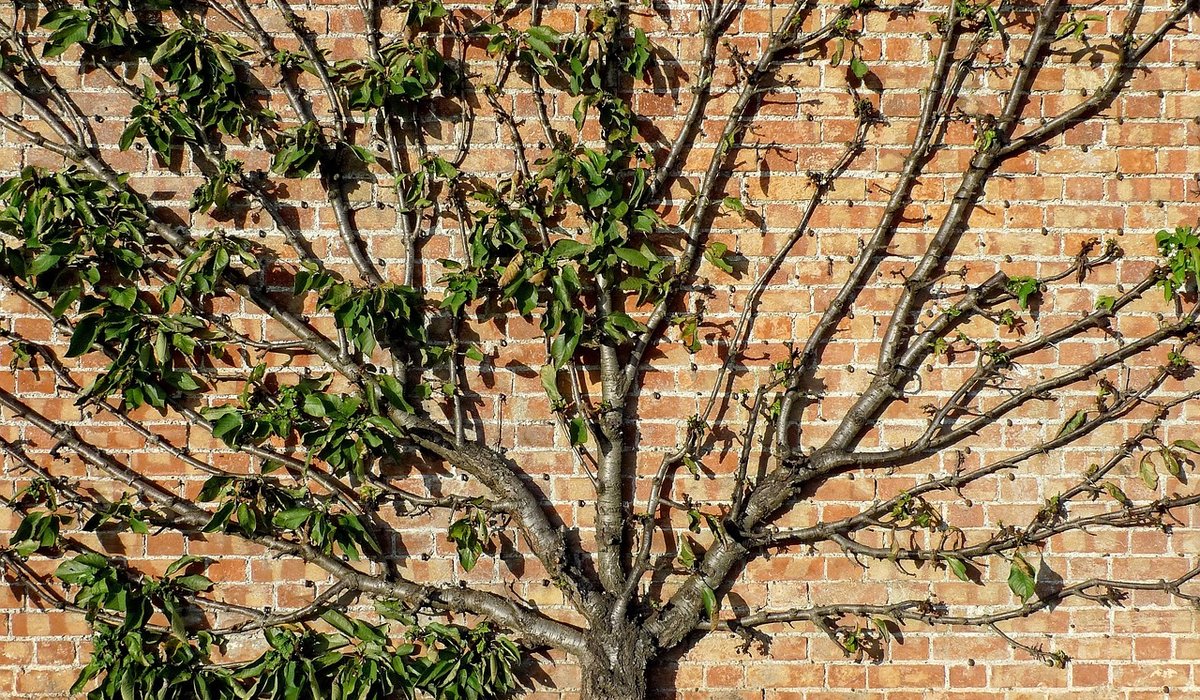
This is where you win the long game. Aim for an open, goblet-shaped tree with a clear centre, so sunlight reaches the middle for at least part of the day and leaves dry within a couple of hours of rain. Work through the tree each winter and take out:
- crossing, rubbing and inward-growing branches;
- congested spur systems, thinning them so air can pass through;
- any shoots carrying the white felt of mildew, cut back into clean wood.
Always cut to a healthy outward-facing bud and leave no stubs. Choose a dry spell, since pruning wounds in wet weather invite canker, and clean your tools between cuts when you are working through infected wood. On young trees, go over the tips again at pink bud to remove mildew shoots that have already broken. For trained forms and dense old trees, a light summer prune in late July or August opens the canopy without provoking a flush of soft growth that mildew would relish.
Clear the ground and plan for next season
Orchard hygiene matters as much as the secateurs. Rake and remove fallen leaves in autumn, mowing beneath the trees and collecting the cuttings rather than leaving them in the grass; that leaf litter is next spring's scab nursery. Pick up mummified fruit and shrivelled fruitlets, and cart prunings off site or burn them. Keep the ground around the trunks clear of weeds and long grass so air moves freely at low level.
Go easy on nitrogen. Rich, sappy growth is exactly what mildew wants, so feed modestly and lean towards potash and a good mulch instead. Water at the roots early in the day, never over the leaves in the evening. If you are planting, varieties such as Katy, Liberty and Florina show useful scab resistance, while cider apples can be chosen with a little more tolerance for a blemished skin. Then next spring, walk the trees from bud burst with your eyes open, and you will catch trouble while it is still small.


Leave a reply